Unscripted Small Business Interview With H&H Construction: Building Relationships Through Home Renovation
Jeremy Rivera of Unscripted Small Business by Permacast Walls: I’m here with Alec and Josie Davis of H&H Construction in Cookeville, Tennessee. I’ve talked to both of you separately and got some great insights, but you know, anytime there’s a duo or there’s two influences within a company, there are different forces at play—you might have different opinions. So let’s dive into what makes H&H Construction special.
What H&H Construction Does
Jeremy: Alec, let’s start with the basics. What would you say you do here at H&H Construction?
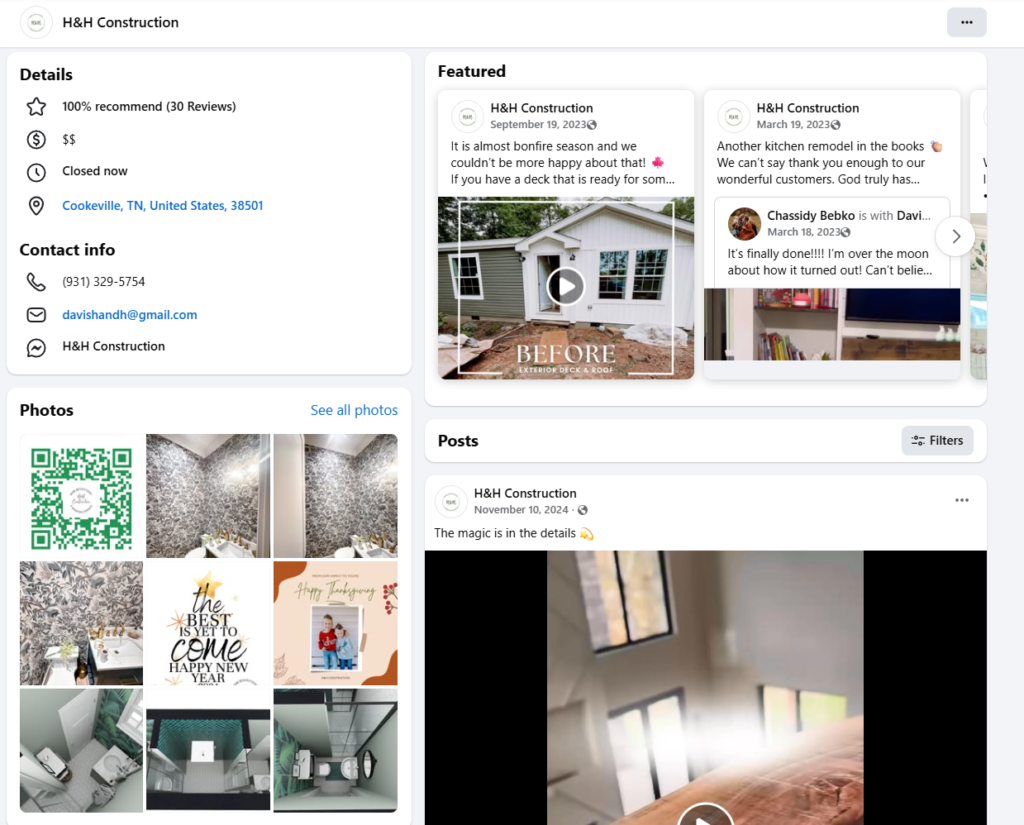
Alec: Well, we do a little bit of everything. It’s honestly easier to say what we don’t do. But we handle everything from home renovations, remodels, decks, electrical, plumbing, HVAC, drywall, painting, flooring, tile—I mean, just a little bit of everything, honestly.
Jeremy: Does that come out of your experience? Are you looking to be a universalist solution for people in Cookeville, or is it just that renovation naturally includes many of those things?
Alec: A little bit of both. My history—I worked for my dad as a teenager. He owned a manufactured home business, so summers I was painting homes for him, installing vapor barrier underneath, doing vinyl siding, whatever it was. I gained a lot of experience working for him.
Then I went to college for a few years, went to trade school for HVAC, and worked in that field for several years before deciding to go into business for myself. It started with Pinterest, actually—my wife’s discovery of Pinterest with little projects and arts and crafty things. It just slowly grew from there.
I was doing projects around the house for people, and the jobs incrementally grew. If I didn’t know how to do it, I learned how to do it. Eventually I got my general contractor’s license. Now, if we can’t do something ourselves, we’ve got subcontractors and people in the trades who can. But we try to do most things ourselves.
The Philosophy Behind Renovation
Jeremy: Josie, you have a different perspective on this—more from the creative and design side. What is it about the process of renovation that you guys seem to enjoy and embrace?
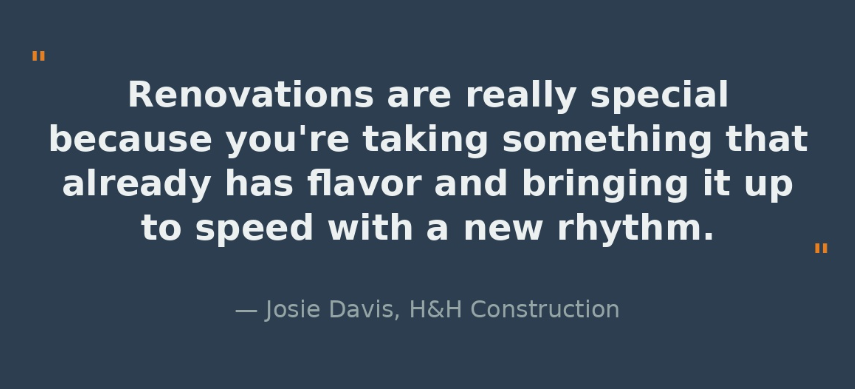
Josie: I think renovations are really special because you’re taking something that’s already there and already has flavor. It already has its own embodiment, and you are tweaking it, aesthetically smoothing it out, maybe changing some of the rhythms there in the space, but you’re ultimately still keeping the foundation and the bones the same.
One of the things I really like about renovations is that you can take something that maybe has been worn and been through life and then bring it up to speed with a new rhythm or a new flavor or a new perspective. It’s nice to see history woven with new age and new influence.
I think that there’s a lot of beauty in the bones. There’s also a lot of termites and mold, but there’s a lot of beauty too. And I think that can be harnessed and made really beautiful again.
Small Repairs vs. Major Renovations
Jeremy: Is what you’re doing largely fixes—finding things that are broken or need to be pulled out and repaired, whether that’s walls or cupboards falling apart—or is it more focused on taking and upgrading a space that’s not necessarily broken but could be better? I work with a number of luxury brands AMBR London, what is it about “luxury” that you can bring to ANY project?
Josie: That’s such a hard answer to give you because I think it’s twofold. I think that in order to get to a place where customers are ready to build the relationship with you that it takes to upgrade a space successfully, they often start with smaller repairs.
To me and Alec, there’s no small job. Every job has an impact to the customer and to the family that’s living in the home. Whether it’s a small hole of drywall that needs to be repaired, or baseboards coming off in one room—those small repairs, just like any relationship you have, those small points of contact always create a smooth relationship into upgrading spaces, upgrading aesthetics.
The more you build a relationship with someone, the more they trust you with the bigger things.
Jeremy: So what’s the vision for the future?
Josie: If I could speak straight from my heart and Alec’s heart—what we would like to see in the future vision of the business is that we really enjoy moving into home additions, larger renovations, large kitchens, bathroom remodels, sunrooms, decks, things of that nature.
Mostly because we do really enjoy the relational aspect of working with our customers. From the first phone call all the way to seeing the finished product—that could take months. A lot of our customers frequently say, “We don’t know what we’re gonna do once we’re not talking to you every day.” We become friends and become family, and I think that’s really important. That’s the heart behind Alec and I and why we do what we do to begin with.
Alec: Lately we’re getting more interested in larger scale projects—home renovations or additions. We’ve been doing additions recently. That’s kind of what our focus is mainly now, not to say that we don’t still do the other things we’ve done in the past. We still do everything, but more recently we’ve been doing home additions and larger scale projects.
Kitchen Remodels: Creating Vision
Jeremy: What are some of the things you’re looking to do in a kitchen remodel that really brings value to a space?
Alec: Josie’s got the vision. Just making the most of the space to meet the needs of the homeowner and their vision for what they want and what they can see but can’t put together—that’s what we’re trying to accomplish when it comes to a kitchen.
So cabinetry design, spacing of the cabinets, what type of cabinets to go where, peninsula versus an island (if it’ll work in the space or not), what type of countertops, if you want backsplash or not, replacing faucets, flooring, paint colors—you name it. Installing hoods and cooking spaces, garbage disposals, dishwasher installation. We pretty much do it all within a kitchen.
A lot of people don’t have vision for space. That’s a huge thing. We’ve worked with so many people who cannot visualize what the space needs. And if you don’t have that vision, it’s hard without having somebody to say, “What if you did this? What if you did that?” So we also help with creating that vision for people who struggle with seeing their space and what it could be.
Josie: When you’re working with a husband and wife team like us—a midsize organization—we have more time, and we carve out more time to be very specific with the customer themselves.
When you’re working with larger corporations, there’s more of a streamlined process, and that can be really helpful for cookie-cutter new builds or suburban neighborhoods. But when you’re working with midsize companies, we like to keep the relational aspect there. We dedicate a lot of time to getting to know the customer, hearing what their goals are. And because of that, we can be more creative in how we attack things.
I will spend hours researching different formats for kitchens if there’s something the customer’s really wanting to see or they’re really wanting a feel or rhythm in their kitchen that they don’t currently have. I’ll spend hours researching that just for them.
The Question of Feel
Josie: I think we can get too stuck into limitations of the space or formulas—you know, in a kitchen you have the triangle formula, things of that nature. That’s all really valuable as a landing place. However, how you’re wanting a space to feel should often also dictate how you develop this space.
That’s a question I always ask: How do you want it to feel? What do you want it to feel like when you walk in? And how can we make the space match that feel for you?
Jeremy: I really like that viewpoint because one of the questions that comes up when people are doing research on home renovation is, “What’s the value input-output? How much am I putting into this versus how much I’m getting out of it?” I like that viewpoint of thinking of it from, “Well, what you’re investing in is changing a space that you’re living in.”
Josie: Yes! It’s only as useful as it is valuable to use. I will give customers feedback on how they want their space accordingly. If you’re wanting to resell a space, I still go by the feel.
The other thing is—it really does matter whether the customer’s planning for this to be their forever home or if they’re planning to flip it or just make it better than it is but not planning to be here forever. Because if you’re looking at resale value, then there are really standard rules of thumb you’re going to use. But if it’s somebody’s personal home that they’re planning to live in potentially forever, then my perspective on that is make it what you want. Make it what you want it to be.
If you’re going to spend money and invest that in your space and you’re planning to be there forever, then we really want to customize it to what you’re wanting to feel.
Favorite Projects: Wet Rooms and Historic Charm
Jeremy: What’s the most fun space that you’ve renovated—either a bathroom or a kitchen—where at the end you’re like, “I wasn’t expecting that”?
Josie: I think wet rooms are really fun. We’ve done several wet rooms. If you’re not familiar with a wet room, it is a bathroom where the shower is literally the whole space. The floors are tiled, the walls are tiled. The shower has no start, no finish. The whole bathroom becomes the shower, basically.
We’ve done a couple of wet rooms where they’re isolated slightly inside of a bathroom, and those are really cool to see finished because the space is so aesthetically clean and smooth. It’s almost like artwork where one thing stops, the next thing starts with very seamless transitions.
I also think that we’ve done several renovations where the houses are incredibly old—when we’re talking old, I mean like thirties, forties, where probably the bones are no longer there and we’re reinforcing the bones to help keep it up. I always think those turn out really cool, especially if you have customers that take some of those older foundational points of view—like the floors—and they refinish them, but then everything else is upgraded.
We’ve also seen customers do that with a fireplace where they’ll keep a fireplace even if it doesn’t work because the bones are just unfortunately no longer workable, but they want to keep the brickwork. They want to keep the mantle old, and then we basically just clean it up, shine it up and polish it, but we keep it with that character.
Honestly, I think those are my favorite. I think that those are the most beautiful spaces when you marry the older charm with the newer aesthetics. I think it’s really pretty.
Home Additions: When and How
Jeremy: What should people be thinking about when considering a home addition versus a renovation? What are the limitations or feasibility factors?
Josie: I go back to the original idea of: You want more space? Are we talking three years and more space? Are we talking 10 years? Are we talking 20 years? What is the livable space that you’re wanting to add?
I am of the opinion—which is slightly different than most people when you think of business owners—some houses, the way that they’re structured, they’re just perfect the way they are. Like if you have a single-family home that’s about 1,100 square feet, a beautiful roofline, sometimes it’s meant to be that way. And so adding onto that changes the feel of that home. I would say, “Nah, friend, just go ahead and find a new place that you can grow into.”
However, I think truthfully, you get the right contractor and the right budget, and you can do just about anything. And I don’t say that lightly. If you’re wanting to add 1,000 square feet on the end of your home, as long as you’re within the parameters of the city limits, the county, your acreage lines and where your home line falls—as long as you’re within those legal limits—you can pretty much do anything.
I think the biggest thing is having the right contractor that can meet your style, understand what you’re wanting, and will go the extra mile. Your monetary budget has to be able to meet that. So I think those are the two things I look at, as well as your timeline.
The other thing customers don’t think about is roofline. That’s a big one. We have some great subcontractors we work with that can give really great opinions on rooflines. I’ve seen customers walk away altogether just because their current roofline won’t match the new roofline and there’s no way to make them match.
In my opinion, a good addition never feels like an addition. It feels like you’ve successfully continued to walk through the house from start to finish, even once it’s done.
Sunrooms: Bringing Nature Inside
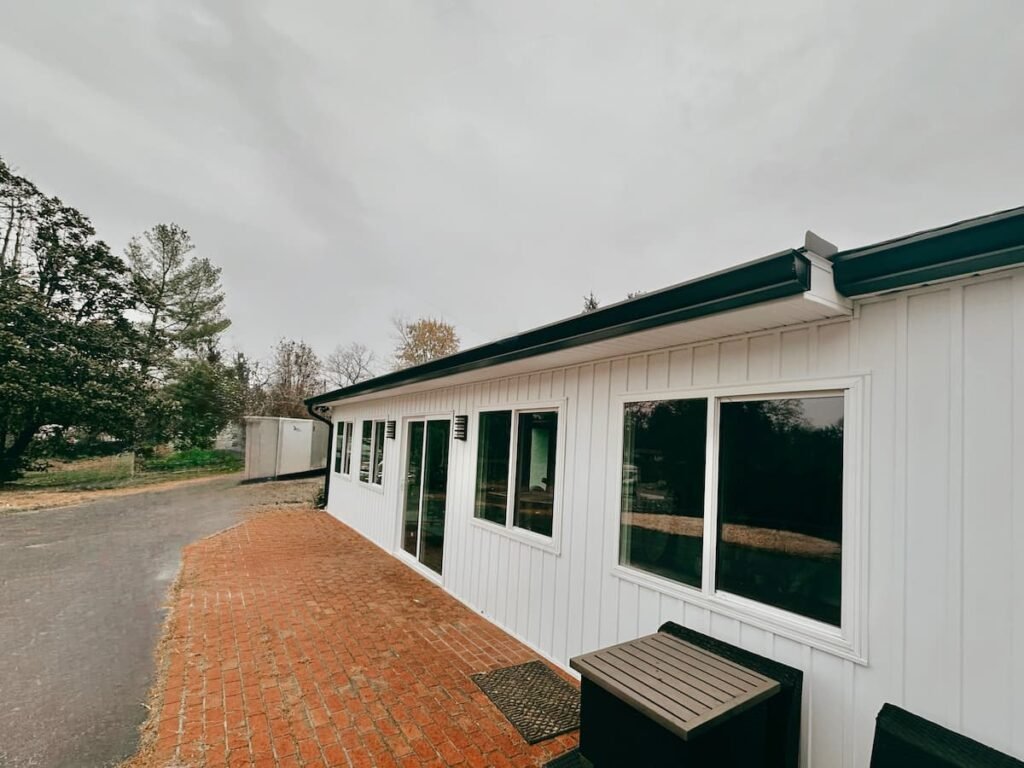
Jeremy: Let’s talk about sunrooms. How do you define what makes a sunroom different from just an addition with lots of windows?
Josie: If you were asking me, a sunroom is being outside and enjoying outside without being outside. A sunroom is by nature an addition to a home or a closing in of a space that maybe is already there. We’ve created sunrooms out of decks, for instance.
So that would be, “I want to feel nature without being outside.” We’ve made sunrooms out of existing outdoor spaces—often like a deck or an awning situation, a front porch, a back porch. We’ve also made sunrooms out of last-minute add-on sheds.
Typically sunrooms bring the elements of nature inside. You’re looking at lots of windows. You want it to be really open. You typically would see skylights in those. Most people like for the room to feel very open, very inviting to the outside eye. You don’t want solid walls because you’re not engaging the elements of nature if your walls are solid.
Alec: Sunrooms can go either way—more of a conditioned or a non-conditioned space. Conditioned space would be preferable, and most people go that route too, so that they can include it in their square footage and utilize it more during the hot and colder months.
A lot of people will use a sunroom in the summer where they’ll get all the natural light, the benefits of the natural light, but the comforts of having an air-conditioned space, which is where I lean toward as well.
Jeremy: So that’s kind of the dividing line between a covered patio versus a sunroom—screens instead of glass?
Alec: Pretty much. With a covered deck, you’ve got deck boards that you can see through. With a sunroom, you would have a solid floor, subfloor, whatever type of flooring you want—vinyl tile, linoleum, whatever it may be. Drywall on the walls as opposed to screen. Thermopane windows, energy-efficient windows. So it’s just more of a sealed-off space, like the inside of your home, essentially.
Decks and Outdoor Spaces
Jeremy: Coming back to covered patios and decks—what are some of your thoughts and advice for people considering adding them?
Josie: I think it depends mostly on what you’re going to use it for and the nature of the home you currently have.
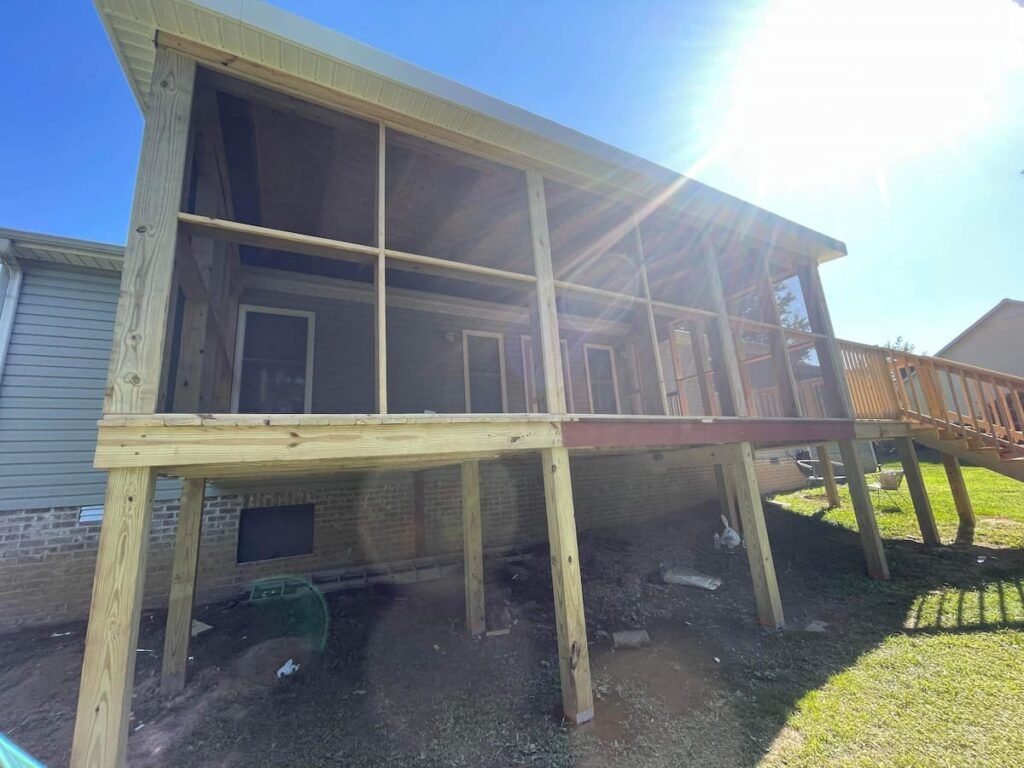
A lot of customers want a patio, want the feel of a patio, but they cannot have it because we’re in Cookeville, Tennessee. There’s a lot of mountain ranges. You can’t have a patio without flat land. Honestly, excavation is incredibly expensive. So it’s pretty costly to try to level some land to have a patio built.
A lot of times in this area, people and families try to achieve a patio feel by adding a deck because with a deck you have posts set in the ground—your ground doesn’t have to be level for a deck to be level. So they use that and they want to get a patio feel. That’s why you’ll often see lean-to style roofs, gazebos, grill areas with pergolas—things like that.
We’ve done pergola areas on decks, and that’s to achieve the feel of a patio. I really enjoy a nicely built deck with a pergola. I think it’s incredibly useful but also really aesthetically pleasing to the eye. It looks really nice. It can be used in a lot of different ways for families.
Alec: I love decks. We’ve done a lot of decks. As far as decking material, either you go with standard 5-quarter boards, which is what you see on most decks, or more of a Trex or a hybrid material for decks which prolongs the life of your deck. There are pros and cons to both.
As far as deck layouts, I love anything that’s out of the norm, anything that’s different. We’ve done several that are different—multi-level decks, decks with grand staircases, decks with fire pits within them, octagonal decks. There’s a million ways that you could do it, and I love the different kinds of ways.
Not to say that I don’t enjoy a standard 12-by-12 deck. But we listen to whatever the homeowners’ needs are, what they’re trying to accomplish, what they’re trying to utilize it for, and try to build around that so they can get what they want out of it to the most that they can.
The H&H Value Proposition: Relationship First
Jeremy: I saw something that Chris Tweten of Space Bar Collective was saying about chatGPT, Ai overviews and all of these Ai tools -That as a small business “You’re competing to be selected.” Any last thoughts on your approach—what is it that you’re bringing to the table as a company, as a team, that makes you stand out?
Josie: Truthfully, if you meet us and you don’t want to go get coffee with us, then find a contractor that you really enjoy speaking with. I think construction in general is a really hard transition. It’s a very life-altering situation no matter what you’re looking at, especially if it’s a large add-on or a deck or a sunroom.
Wherever you’re putting your value and your money is incredibly important. Because of that, Alec and I are dedicated to making sure that we are building relationship with the people that we meet. We truly want what’s best for them aside from limitations of what construction brings.
I think sometimes people feel like they have to go with one person. I would just encourage them that construction is a marriage of a certain form. You’re gonna be spending a lot of time with those people. Enjoy the people that you’re meeting. Be willing to communicate with them. If you can’t, keep looking. I don’t take that offensively. If we’re not a right fit for someone, that’s okay with me, as long as they’re able to find the right fit for them.
As far as bringing things to the table, Alec and I want to talk. We want to pray over your family. We want to meet your children if you’re willing. We want to encourage you in steps of life. We also want to be there to support you.
Through construction, you’re going to find—no matter where and no matter what contractor you have—there’s a lot of dust, a lot of unexpected terrain, a lot of hoops to jump through. Truthfully, the more relationship you have with who you’re working with, the better you’re going to be and the more stable you’re going to feel and the more safe and the more excited you’re going to feel about the end result.
That’s the primary goal for Alec and I. We hope that everyone that interacts with us feels welcomed, feels as though they were taken care of and were heard and listened to and held. If that is done, then our job’s been done.
That doesn’t always mean that everything turns out perfect. That doesn’t always mean that there’s not going to be hoops and conflict and unfortunate things that happen or materials that are lost in the shuffle. But it does mean that at the end of the day, they know that they can come to us, they can talk to us, and we will do our best to make sure that they feel heard and that they end up with a result that they’re excited about.
So if it’s not us, that’s cool—but I hope that we’re able to work with anybody that comes our way.
For more information about H&H Construction, visit them in Cookeville, Tennessee.