Sunroom vs. Traditional Home Addition: Which Is Right for Your Tennessee Home?
When your family needs more space, you have two main options: build a traditional home addition or add a sunroom. Both expand your living area, but they differ significantly in cost, construction time, functionality, and return on investment.
Here’s an honest comparison to help you decide which makes sense for your home, your budget, and your lifestyle.
The Fundamental Difference
A traditional home addition (sometimes called a “stick-built” addition) is constructed using the same materials and methods as your original home—wood framing, concrete foundation, standard drywall, full insulation, integrated HVAC, and electrical throughout. It becomes a seamless extension of your house, indistinguishable from the original structure.
A sunroom is a glass-enclosed living space designed to maximize natural light and views of the outdoors. Depending on the type, it may or may not include climate control, insulation, or utility connections. Sunrooms range from simple screen rooms to fully insulated four-season rooms that function year-round.
As the experts at Angi explain: “A room addition is a year-round, fully habitable add-on to a home. A room addition includes electricity, HVAC, plumbing, and finished walls, so it extends your living area rather than supplementing it like some sunrooms do.”
Cost Comparison: Sunrooms Win—By a Lot
This is where sunrooms have a clear advantage.
Traditional Home Addition Costs:
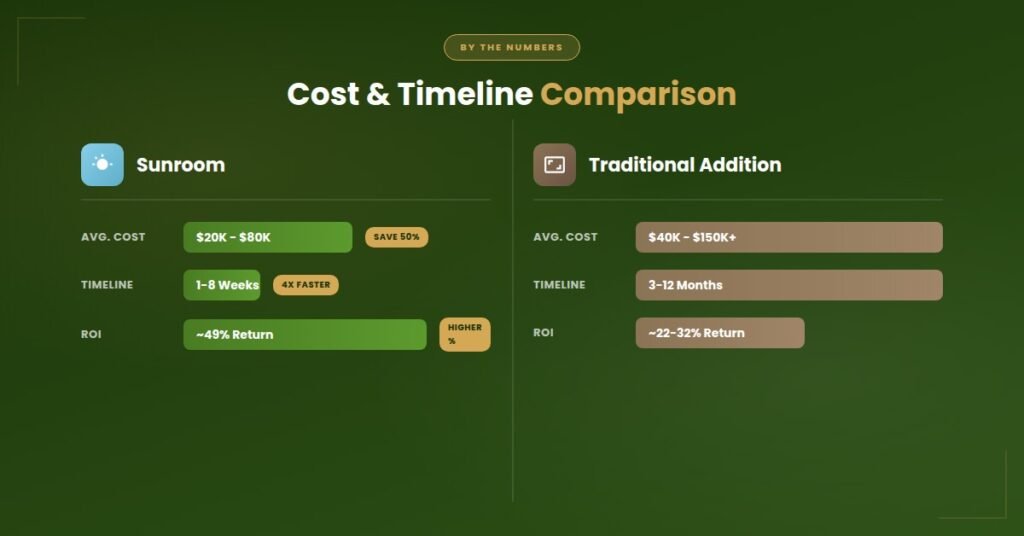
- Average range: $80 to $200+ per square foot
- Typical project: $40,000 to $100,000+
- Complex additions (second story, master suite): Can exceed $150,000
Sunroom Costs:
- Screen room: $8,000 to $25,000
- Three-season room: $20,000 to $50,000
- Four-season room: $35,000 to $80,000
- High-end solarium: $50,000 to $150,000
For a deeper breakdown of pricing factors specific to our area, see our guide on how much a sunroom addition costs in Tennessee.
According to Pacific Patio, a sunroom specialist: “Many homeowners who want a room addition are surprised at the cost, as they can run upwards of $100,000. Therefore, many budget-conscious homeowners opt for sunrooms, which typically cost about half of traditional stick-built room additions.”
The cost difference comes down to materials and labor. Traditional additions require full foundations, framing, roofing, siding, drywall, plumbing rough-ins (even if not used), and complete HVAC integration. Sunrooms use pre-engineered components that install faster with less specialized labor.
Construction Timeline: Weeks vs. Months
If minimizing disruption to your daily life matters, sunrooms have a significant edge.
Traditional Home Addition Timeline:
- Simple addition: 3 to 4 months
- Complex addition: 6 months to 1 year+
- Factors: Permitting, weather delays, subcontractor scheduling, inspections
Sunroom Timeline:
- Prefab/kit sunroom: 1 to 2 weeks
- Custom three-season room: 2 to 4 weeks
- Four-season room: 4 to 8 weeks
Patio Enclosures notes that their prefabricated sunrooms are “typically installed in a matter of days after the peripheral items such as foundation work is complete”—compared to “weeks or even months” for traditional construction.
At Cookeville Sunrooms, most of our installations are completed in one to two weeks, meaning less noise, less mess, and less time living in a construction zone.
What Can You Use the Space For?
This is where traditional additions pull ahead—they’re more versatile.
Traditional additions can be used for:
- Bedrooms (including master suites)
- Bathrooms
- Kitchens or kitchen expansions
- Home offices with full utilities
- In-law suites or ADUs
- Any room requiring plumbing
Sunrooms work best for:
- Family rooms and living spaces
- Dining areas
- Home offices (with electrical)
- Playrooms
- Reading nooks and relaxation spaces
- Indoor gardening and plant rooms
- Exercise areas
- Three-season entertaining
The Champion Sunroom Buyers Guide puts it simply: “You can use your sunroom in almost any way you would use a typical room, with one exception: A bedroom. Too many windows can leave some people feeling exposed and vulnerable, and a bedroom is a place where people want privacy.”
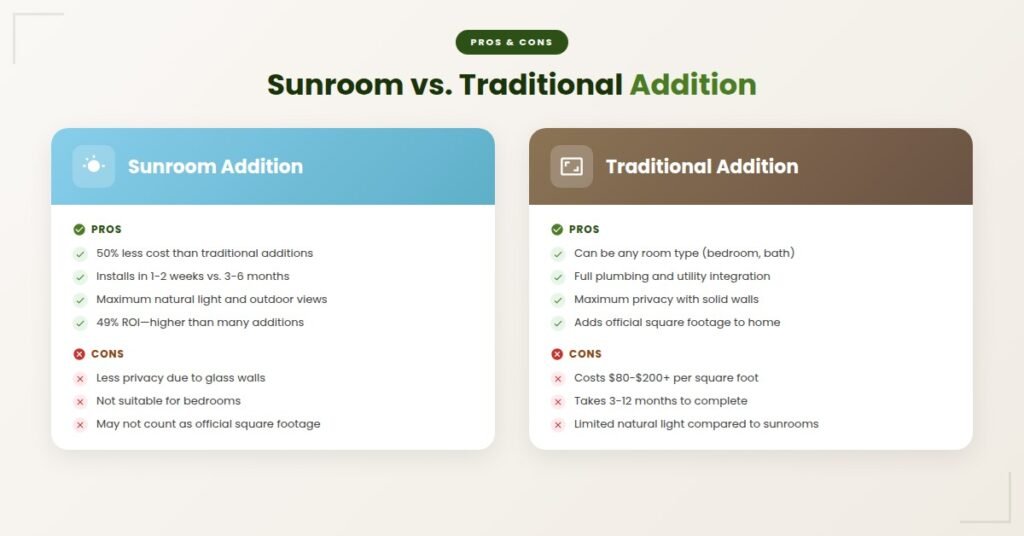
If you need a bedroom, bathroom, or space with plumbing, a traditional addition is your only option. For almost everything else, a sunroom delivers comparable functionality at lower cost.
Natural Light and Connection to Outdoors
This is the sunroom’s superpower.
Traditional additions have windows, but they’re designed like any other room—solid walls with window openings. Sunrooms are designed around glass, with walls that are 50% to 98% windows.
The result is a fundamentally different experience. A sunroom floods with natural light, offers panoramic views of your yard, and creates a sense of connection to the outdoors that a traditional room simply cannot match. The design work is in joining that glass room to the house cleanly, so it reads as part of the home rather than something bolted on afterwards.
For homeowners who want to enjoy nature without the bugs, weather, or seasonal limitations, this is often the deciding factor.
Year-Round Usability
Traditional additions win here—they’re built to the same standards as your home and work identically year-round.
Sunrooms vary based on type:
- Screen rooms: Spring through fall only (if you’re weighing this option, see our comparison of screened-in porches vs. sunrooms)
- Three-season rooms: Comfortable except during winter extremes
- Four-season rooms: Year-round comfort with proper HVAC
If you choose a four-season sunroom with heating and cooling, the usability gap disappears. These rooms can be just as comfortable as any other room in your home—they just happen to have better views.
As JSB Home Solutions notes about sunroom flexibility: “Unlike a guest room or home theater, which serve specific purposes, a sunroom can evolve with your needs. It can start as a playroom for young kids, transition into a home office, and later become a relaxation space for retirement.”
Privacy Considerations
Traditional additions offer more privacy due to solid walls with limited windows. This matters for:
- Bedrooms
- Bathrooms
- Home offices where you’re on video calls
- Homes with close neighbors
Sunrooms, by design, have extensive glass. If privacy is a concern, you can address it with:
- Strategic placement (facing your backyard rather than neighbors)
- Blinds or shades
- Tinted or frosted glass options
- Landscaping screens
But if maximum privacy is essential, a traditional addition is the better choice.
Return on Investment (ROI)
Both options add value to your home, but they do so differently.
Traditional additions typically add more raw value because they increase your home’s official square footage, which directly impacts appraisals. According to Remodeling Magazine’s Cost vs. Value report, home additions recoup roughly 22% to 32% of project costs at resale.
Sunrooms often don’t count toward official square footage (depending on local appraisal standards), but they still add value through:
- Increased buyer appeal
- Differentiation from comparable homes
- Lifestyle value that attracts specific buyers
Angi’s data shows sunrooms deliver approximately 49% ROI—actually higher than many traditional additions in terms of percentage return. We explore this topic in depth in our article on whether a sunroom adds value to your home.
Custom Built, a Michigan contractor, offers this perspective: “It’s important to set expectations clearly. Just like the stock market, past performance doesn’t guarantee future results… What we can say with confidence is that home improvements almost always bring value. Maybe not dollar-for-dollar when you sell, but value in the sense that your home becomes more functional, more beautiful, and more enjoyable.”
Which Should You Choose?
Choose a traditional home addition if you need:
- A bedroom or bathroom
- Plumbing (kitchen, wet bar, laundry)
- Maximum privacy
- Space that counts toward official square footage
- A room indistinguishable from your original home
Choose a sunroom if you want:
- A bright, light-filled living space
- Connection to the outdoors year-round
- Lower cost and faster construction
- Minimal disruption during building
- A flexible family space, office, or entertaining area
- Maximum natural light
Consider a four-season sunroom if you want:
- The benefits of a sunroom
- Year-round comfort in Tennessee’s climate
- A space that functions like a traditional room
- The best of both worlds
The Middle Ground: Four-Season Sunrooms
For many Tennessee homeowners, a four-season sunroom offers the ideal compromise. You get the light, views, and outdoor connection of a sunroom with the year-round functionality of a traditional addition—at a price point between the two.
Our four-season rooms include:
- Full insulation for Tennessee winters and summers
- HVAC integration or ductless mini-split options
- High-performance glass that blocks UV and retains heat
- Electrical for lighting, outlets, and ceiling fans
- Finishes that match your home’s interior
Both sunrooms and traditional additions require permits in Tennessee—we handle all the paperwork for you. For more details on what’s involved, read our guide to sunroom permits, inspections, and property taxes.
The result is a room you’ll use every day of the year, not just when the weather cooperates.
Questions to Ask Before Deciding
- What will this space be used for? If it requires plumbing or bedroom-level privacy, you need a traditional addition.
- What’s your realistic budget? Sunrooms deliver more space per dollar spent.
- How important is natural light? Sunrooms offer dramatically more than traditional rooms.
- How quickly do you need the space? Sunrooms install in weeks; additions take months.
- Do you want year-round use? Four-season sunrooms match traditional additions for comfort.
- How long do you plan to stay in your home? If you’re staying long-term, prioritize what you’ll enjoy daily. If selling soon, consider resale appeal.
Ready to Explore Your Options?
At Cookeville Sunrooms, we specialize in helping Tennessee homeowners add beautiful, functional living space without the cost and disruption of traditional construction. Our BetterLiving sunrooms come with a 50-year warranty and install in as little as one to two weeks.
Schedule a free consultation and we’ll visit your home, discuss your vision, and help you determine whether a sunroom is the right solution for your family.
Contact Cookeville Sunrooms | Call for a free in-home consultation